Table of Contents
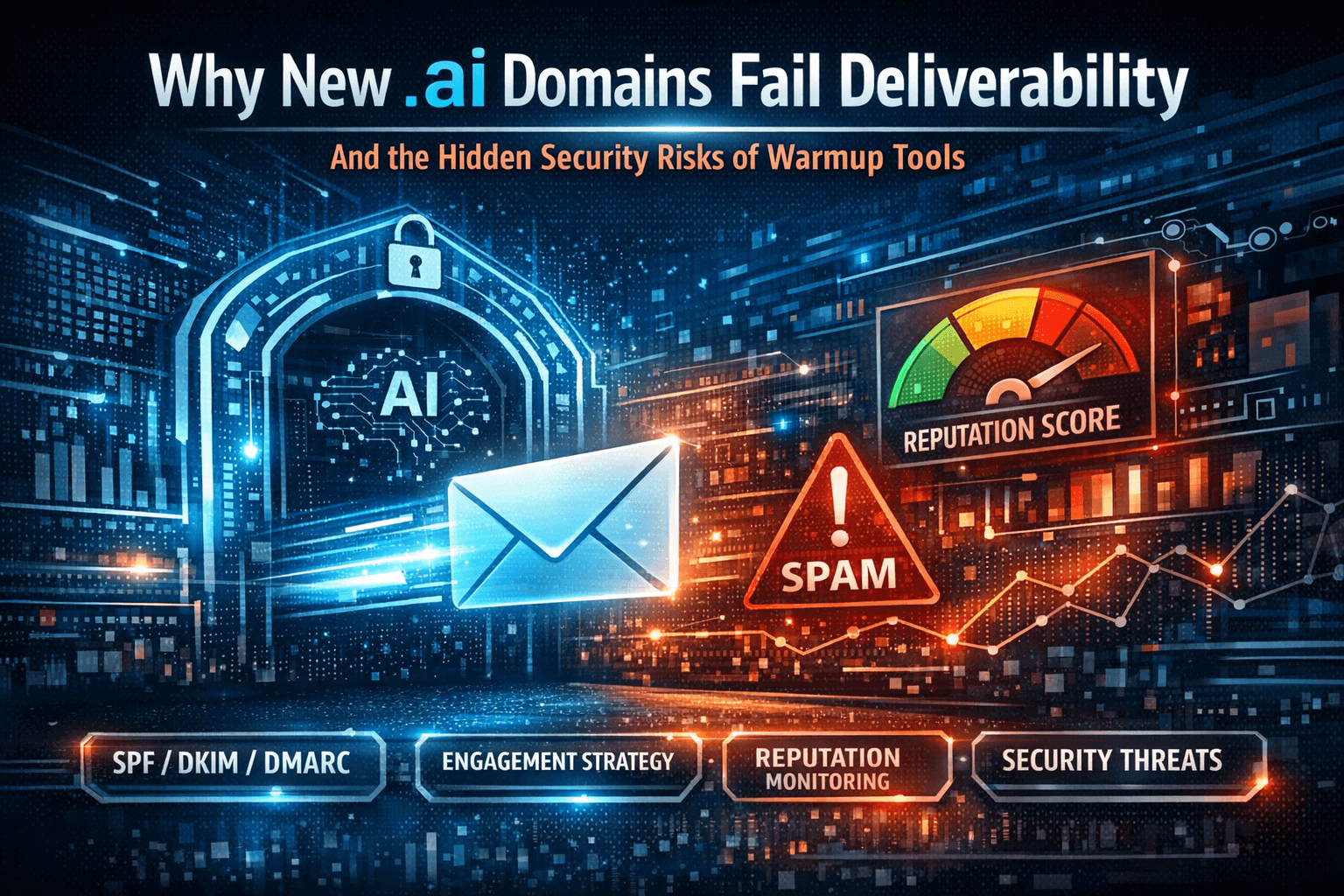
Email deliverability in 2026 is no longer a simple matter of SPF, DKIM, and DMARC best practices. Those are table stakes. Modern "inboxing" is driven by behavioral signals, domain reputation, and security posture — and new email domains, especially .ai, start at a severe disadvantage. At the same time, many teams turn to automated warmup services to accelerate reputation building, unaware that these tools introduce significant security risks that most organizations would never accept in any other part of their stack.
This post breaks down the real reasons new domains land in junk, the right way to build reputation, and the security pitfalls of automated warmup networks that technical leaders should not ignore.
1. Why New .ai Domains Get Flagged as High‑Risk
Mailbox providers treat new domains — especially .ai — as unknown senders with zero trust. The .ai TLD has seen a surge in AI‑generated outreach, spam operations, and short‑lived burner domains. As a result, Gmail, Outlook, and Yahoo apply stricter filtering to new .ai senders until they demonstrate:
Consistent sending patterns
Positive engagement signals
Low complaint rates
Clean authentication and DNS posture
Even with perfect SPF, DKIM, and DMARC, a new domain with no history is algorithmically indistinguishable from a newly‑registered spam domain. That’s why authentication alone does not guarantee inbox placement.
2. A Modern Deliverability Strategy (2026 Edition)
Technical Foundation
A trustworthy sender identity requires:
SPF, DKIM, DMARC aligned and passing
Reverse DNS (PTR) resolving correctly
Custom Return‑Path for bounce reputation
Consistent From‑address and domain branding
These signals ensure your domain is evaluated cleanly before engagement metrics kick in.
Reputation Building
New domains must warm up gradually:
Start at 10–20 emails/day, increasing slowly
Avoid volume spikes
Use subdomains to isolate marketing vs. transactional traffic
Send first to warm, engaged contacts
Mailbox providers expect human‑like growth, not automation‑like bursts.
Engagement Optimization
Engagement is the #1 "inboxing" factor:
Personalize deeply
Encourage replies
Remove unengaged contacts
Use double opt‑in
Avoid sending to cold or purchased lists
Low engagement = spam placement, regardless of authentication.
Content Quality
Filters evaluate structure and intent:
Clean HTML
Plain‑text + HTML versions
Minimal links
No spammy language
Consistent branding
List Hygiene
Protect your domain from traps and complaints:
Remove hard bounces immediately
Suppress inactive subscribers
Avoid role accounts and catch‑alls
Never use scraped lists
Monitoring
Use:
Google Postmaster Tools
Microsoft SNDS
Seed testing
Blacklist monitoring
Deliverability is a continuous discipline, not a one‑time setup.
3. The Security Risks of Automated Warmup Tools
Warmup platforms promise faster reputation building — but at a cost most security teams would never accept.
Full Mailbox Access
Warmup tools require OAuth or IMAP/SMTP access, granting:
Read access to all inbound mail
Read access to all outbound mail
Ability to send as your identity
Access to internal communications and sensitive data
This is equivalent to giving a third-party full control of an executive’s inbox.
Exposure of Email Content to Strangers
Warmup networks exchange messages between customers. That means:
Other users may see your warmup emails
Some services expose real message content
Sensitive or internal information can leak
Reputation Bleed
Warmup pools often include:
Low‑reputation domains
Spam‑adjacent senders
Disposable or burner inboxes
Your domain becomes statistically correlated with these senders — a long‑term deliverability liability.
Detectable Automation Patterns
Mailbox providers increasingly detect:
Synthetic reply loops
Identical warmup patterns
Automated engagement
This can trigger:
Spam placement
Account throttling
API access restrictions
Terms‑of‑service violations
Compliance & Governance Risks
Warmup tools may violate:
Gmail API terms
Microsoft 365 acceptable use policies
ESP sending rules
For regulated industries, this is a non‑starter.
4. A Safer, More Secure Path Forward
For security‑mature organizations, the recommended approach is:
Manual warmup with real contacts
Engagement‑driven reputation building
Subdomain isolation
Use of reputable ESPs with shared IP reputation
Strict list hygiene and segmentation
Continuous monitoring
This approach avoids the security pitfalls of automated warmup networks while building sustainable, long‑term deliverability.
Final Thoughts
Deliverability in 2026 is a blend of identity, reputation, engagement, and security posture. New .ai domains face heightened scrutiny, and automated warmup tools introduce risks that most technical leaders would never tolerate elsewhere in their infrastructure.
A disciplined, security‑aligned deliverability strategy is not just safer — it’s more effective.